What is BIM? A Plain-Language Definition
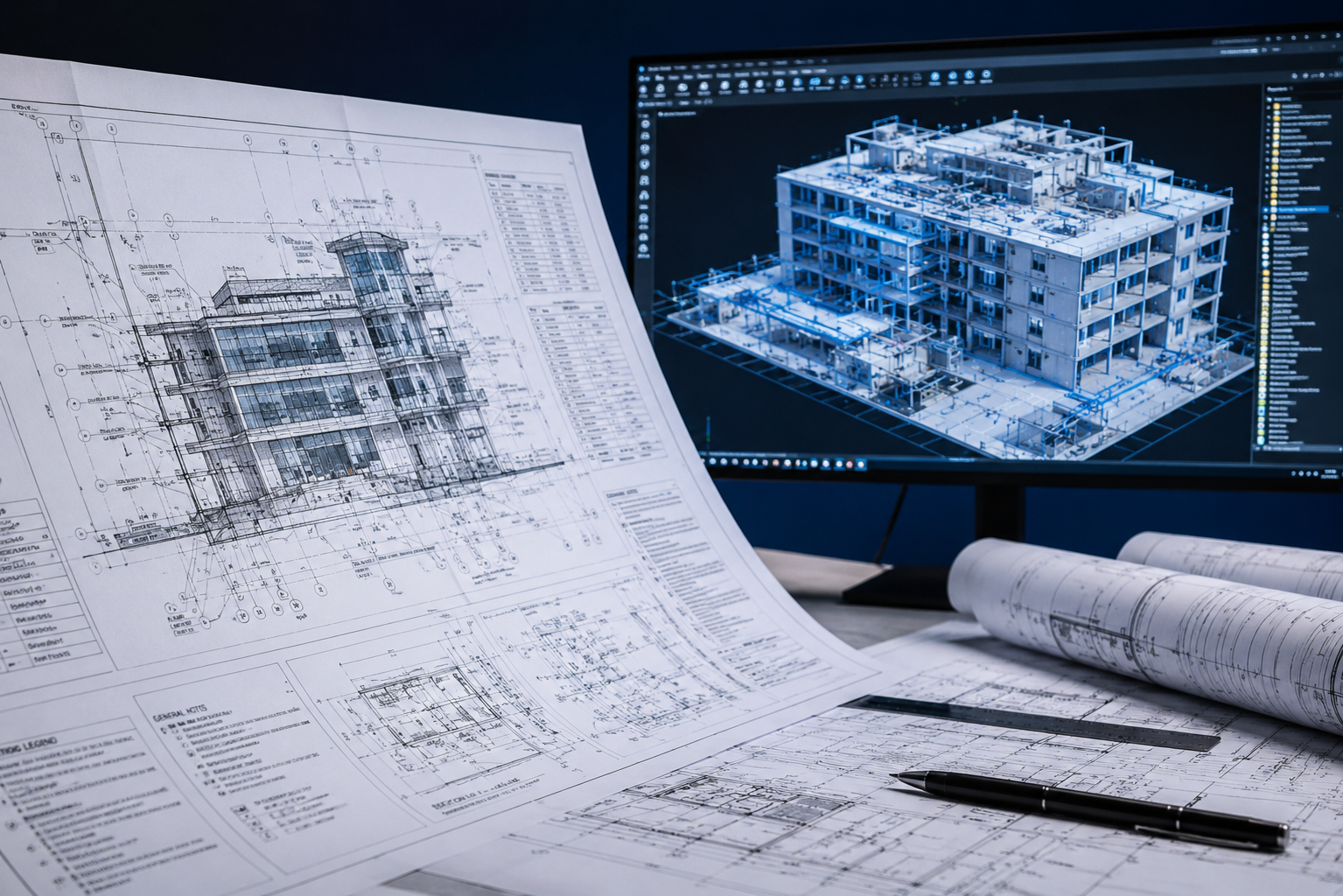
Building Information Modelling — universally abbreviated to BIM — is frequently misunderstood as simply producing 3D drawings in a computer. It is considerably more than that. BIM is the process of creating and managing a digital representation of a building that contains not just geometric information — the shapes, dimensions, and positions of every component — but also data about each component's properties: its material specification, manufacturer, cost, maintenance schedule, and relationship to every other element in the building.
When a structural engineer models a concrete column in a BIM environment like Autodesk Revit, that column knows its own grade of concrete, its reinforcement schedule, its load-bearing capacity, and its position relative to the beams it supports. When the MEP engineer places a duct in the same model, the software understands that the duct occupies physical space and can automatically detect if it conflicts with the structural column. This intelligence — the data embedded in the model, and the relationships between model elements — is what distinguishes BIM from 3D visualisation. The "I" in BIM is arguably its most valuable component.
The Traditional ApproachTraditional CAD Drafting: Strengths and Limits
Computer-Aided Design (CAD) drafting, typically using software like AutoCAD, transformed the engineering industry when it replaced drawing boards in the 1980s and 1990s. Lines that once took hours to draw and revise by hand could be edited in minutes. Drawing sets could be reproduced perfectly, dimensions could be scaled precisely, and drawings could be transmitted electronically. For a generation of engineers, CAD represented the frontier of professional practice.
The strengths of traditional CAD remain real for certain project types. For small, simple projects — a garden boundary wall, a single villa extension, a minor internal refurbishment — CAD drawings produced by an experienced draughtsperson may be perfectly adequate and cost-effective to produce. CAD files are universally readable, require no specialist software to view, and the workflow is familiar to virtually every contractor and authority reviewer in Oman. For projects where the design is straightforward and coordination complexity is low, the additional investment in a full BIM model may not return commensurate value.
The limits of traditional CAD become serious as project complexity increases. CAD drawings are fundamentally disconnected from each other — a change made to a floor plan must be manually replicated in sections, elevations, schedules, and details. In a large project with dozens of drawing sheets, this propagation of changes is where errors accumulate. More critically, 2D CAD cannot detect spatial conflicts between disciplines. An architect's ceiling void and an MEP engineer's duct network exist on separate CAD files, and whether they physically clash can only be determined by a human being carefully comparing drawings — a process that is slow, expensive, and error-prone.
Comparative AnalysisWhere BIM Outperforms CAD
BIM's advantages compound as project scale and complexity increase, and they span the entire building lifecycle from initial design through construction and into long-term building operation.
The most immediately valuable BIM capability for project delivery is automated clash detection. When architecture, structure, and MEP models are federated — combined into a single coordinated model — software like Autodesk Navisworks can run automated clash detection that identifies every location where elements from different disciplines occupy the same physical space. A typical mid-size commercial building in Oman may have several hundred clashes in its initial federated model. Each of those clashes, if discovered on site rather than in the model, represents an instruction to the contractor to stop work, obtain a variation, redesign, and rebuild. The cost of resolving a clash on site is typically 10 to 50 times higher than resolving it in the model. Eliminating 300 clashes before construction begins is a quantifiable, project-saving outcome.
The second major advantage is the automated generation of quantities and schedules. In a BIM model, every element is an object with defined properties — so the model can automatically count all windows of a given type, sum all areas of a specific floor finish, and calculate the total volume of concrete in a structural frame. These quantities can be exported directly into a Bill of Quantities format, dramatically reducing the time required for quantity surveying and — more importantly — eliminating the manual transcription errors that plague traditionally produced BOQs. Our experience is that BIM-generated BOQs are produced approximately three times faster than manually measured equivalents, with a material reduction in quantification errors.
Clash Detection
Automated identification of MEP, structural, and architectural conflicts before construction — eliminating costly on-site variations and rework.
Quantity Take-off
Auto-generated BOQ directly from the model — 3x faster than manual measurement with a significant reduction in quantification errors.
4D Scheduling
Time-phased construction sequencing linked to the 3D model, enabling visual programme planning and early identification of sequencing conflicts.
As-Built Documentation
Accurate as-installed record models that become the foundation for facilities management, maintenance planning, and future refurbishment.
Real Cost Comparison
The upfront investment in BIM is real — the software licences, the specialist skills, and the additional coordination time in the early design stages all represent costs that traditional CAD workflows do not carry in the same way. For a mid-size commercial building in Oman, a full BIM package may cost 15 to 25 percent more to produce than an equivalent CAD drawing set.
However, the downstream savings consistently outweigh this upfront premium when construction complexity is moderate to high. Studies across the Gulf region and international benchmarks consistently indicate that BIM-coordinated projects experience 30 to 40 percent less rework on site than traditionally coordinated equivalents. Given that rework typically accounts for 5 to 15 percent of total construction cost on complex projects, the financial case is compelling. A project where BIM eliminates 10 percent of the construction value in rework has effectively paid for its BIM investment many times over.
The BOQ accuracy benefit has its own financial significance. Inaccurate BOQs produce inaccurate contractor tenders, which produce either budget surprises at award or variation claims during construction — both of which are expensive for the client. A BIM-generated BOQ that is materially accurate sets a reliable project budget and creates a transparent baseline for variation assessment, reducing contractor opportunism and client-consultant disputes that are a regrettable feature of traditionally tendered Gulf construction projects.
When Traditional Drafting Still Makes Sense
An honest comparison must acknowledge that BIM is not always the optimal choice. For very small projects — simple residential extensions, interior refurbishments, single-storey outbuildings — the overhead of setting up a full BIM model and managing all discipline coordination within that framework may genuinely exceed the coordination benefit delivered. If the project is simple enough that the MEP can be specified in notes on an architectural drawing without creating coordination risk, CAD is likely sufficient and more cost-effective.
Similarly, in retrofit and renovation projects where existing conditions are highly variable and the primary design challenge is adapting to what is discovered on site rather than coordinating a new-build design, the value of a fully coordinated BIM model diminishes. Contractors working in existing structures expect to adapt to site conditions, and the design intent is typically conveyed more pragmatically through marked-up existing drawings than through a detailed BIM model of uncertain accuracy.
The honest recommendation: for any new-build project above approximately 500 square metres GFA, or any project with significant MEP complexity, BIM delivers a return on its additional investment. Below that threshold, a judgement call based on specific project characteristics is appropriate — and the right engineering consultant will advise you honestly rather than defaulting to the most expensive tool regardless of fit.
Our PracticeFirst Step Engineering's BIM-First Workflow
At First Step Engineering, BIM is our default workflow for all new-build projects. We operate a fully integrated Revit environment in which architectural, structural, and MEP models are developed in parallel and federated weekly for clash detection during the design phase. Our BIM Execution Plan — the document that governs how BIM is produced, shared, and managed on each project — is issued to clients and contractors at project inception, setting clear expectations for model LOD (Level of Development) at each design stage and the deliverables that flow from the model at each milestone.
We believe that the as-built BIM model is one of the most valuable deliverables we provide to building owners. A building whose MEP infrastructure is fully documented in a digital model that can be queried and updated throughout its operational life has a significant advantage in facilities management efficiency over a building whose infrastructure is recorded only in paper as-built drawings that are filed and forgotten. As Oman's property sector matures and institutional investors demand higher standards of asset documentation, the BIM model will increasingly be recognised as a core component of a building's value — not just a design tool, but a lifelong asset management resource.