What Does MEP Engineering Cover?
When you walk into a completed building and the lights come on, the air conditioning hums quietly, and water flows cleanly from the tap, you're experiencing the result of meticulous MEP engineering. MEP stands for Mechanical, Electrical, and Plumbing — three deeply interrelated disciplines that transform an architectural shell into a liveable, operational space. Despite being largely invisible once construction is complete, MEP systems account for 30 to 45 percent of a building's total construction cost in the Gulf region, and their performance dictates operational energy bills for the building's entire lifespan.
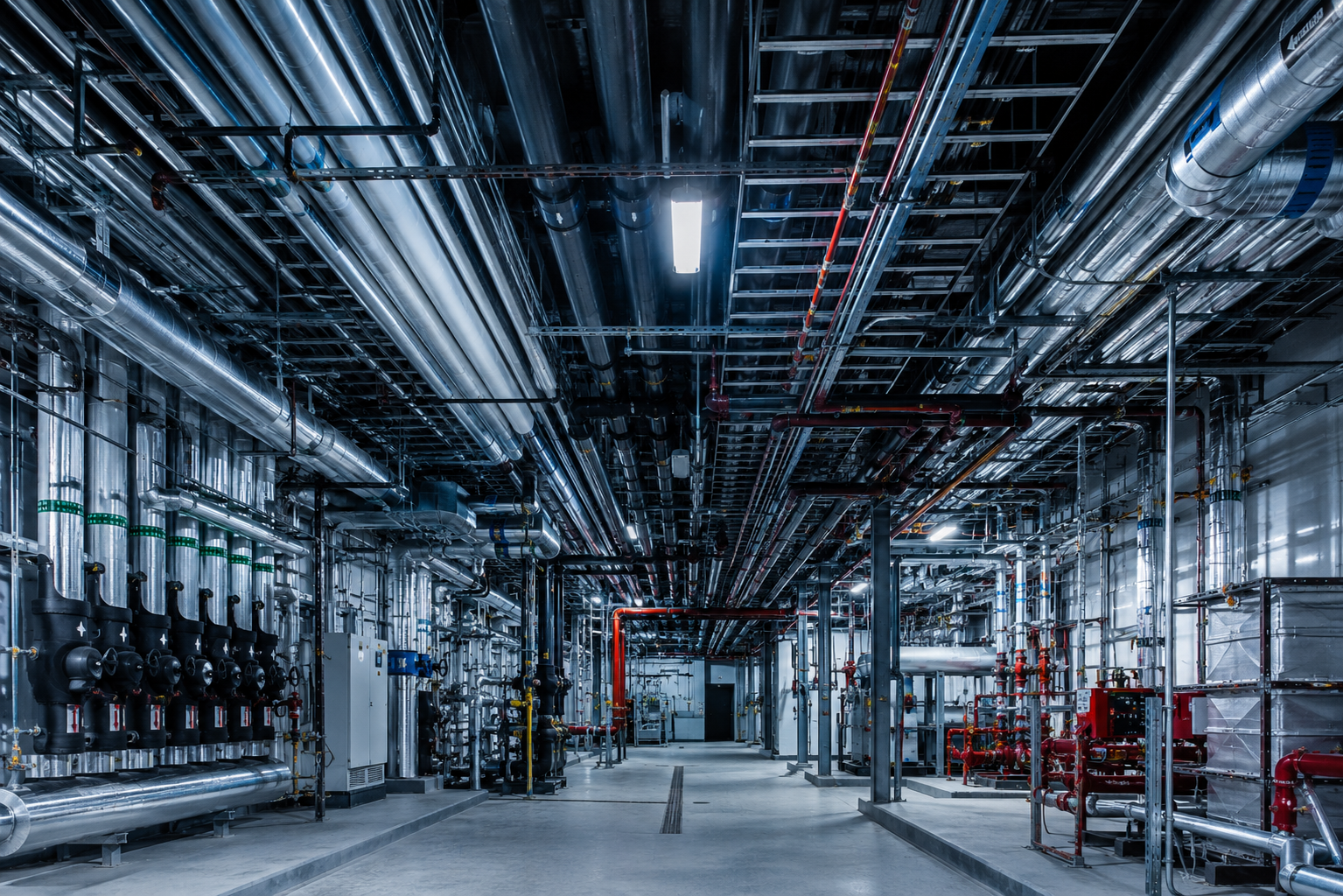
The mechanical component encompasses everything related to climate control and airflow — HVAC (Heating, Ventilation, and Air Conditioning) systems, chiller plants, ductwork networks, fresh air handling units, and fire suppression systems. In Oman's harsh summer climate, where outdoor temperatures regularly exceed 45°C, mechanical engineering is not a luxury — it is a survival necessity. A poorly designed HVAC system will not only fail to keep occupants comfortable; it will consume two to three times the energy of a well-engineered alternative, adding enormous cost over the building's lifetime.
The electrical discipline covers the full low-voltage (LV) infrastructure: main distribution boards, sub-distribution panels, lighting systems, power outlets, emergency lighting, earthing and bonding, lightning protection, and building management system (BMS) integration. Beyond basic power supply, modern electrical engineering in Oman increasingly incorporates solar PV readiness, EV charging infrastructure, and smart building controls aligned with Oman's Vision 2040 sustainability objectives.
The plumbing scope addresses potable water supply and distribution, hot water systems, drainage, soil and waste pipework, sewage and greywater separation, and in larger projects, irrigation and fire hydrant networks. Oman's water scarcity context makes water-efficient plumbing design — pressure management, greywater recycling, and accurate pipe sizing — not just environmentally responsible but increasingly a requirement under revised NBC provisions.
Mechanical
HVAC systems, mechanical ventilation, chiller plants, and fire suppression networks designed for Oman's extreme climate.
Electrical
LV distribution, lighting design, emergency power, earthing systems, and smart building management integration.
Plumbing
Potable water supply, drainage, sewage separation, hot water systems, and water-efficient fixture specification.
BIM Coordination
Clash detection across all three disciplines using federated models, ensuring zero on-site conflicts before construction begins.
Why MEP Planning Must Start at Design Stage
One of the most expensive mistakes on construction projects across Oman — and the wider Gulf — is treating MEP as an afterthought. The architectural drawings are completed, structural engineers size the slabs and beams, and only then does someone call in an MEP team to "fit it all in." The result is inevitably costly: ducts that cannot route without lowering finished ceiling heights, electrical risers that compete with structural cores, and plumbing stacks that require slab penetrations through post-tensioned zones.
When MEP engineers are brought into the design process at concept stage, they influence decisions that are essentially free to change on paper but prohibitively expensive to change on site. Ceiling void depths are established correctly from the start, plant room sizes are properly allocated, structural openings are coordinated before reinforcement is detailed, and riser shafts are positioned to minimise pipe and duct run lengths — reducing both material cost and pressure drop in the system. This collaborative approach, often referred to as integrated design, is the industry standard for projects of any significant scale and is increasingly expected by Muscat Municipality's technical reviewers at permit stage.
Oman's Civil Defence authority also requires that fire suppression, detection, and emergency egress lighting systems be fully designed and documented as part of the building permit submission. A project that reaches Civil Defence review without a coordinated MEP package faces mandatory resubmission — a delay that typically runs eight to twelve weeks in practice.
Common IssuesCommon MEP Failures in Oman Construction
Having reviewed and rescued a significant number of distressed projects across Muscat and wider Oman, our team has observed clear patterns in where MEP goes wrong. The most frequent failure is undersized HVAC — systems specified on the basis of rule-of-thumb watt-per-square-metre estimates rather than proper heat load calculations that account for the building's orientation, glazing ratios, occupancy, and equipment loads. The result is a system that runs at 100 percent capacity on a moderate day and fails entirely during the peak July heatwave.
Electrical overloading is the second major failure category. Panels installed without adequate spare capacity for future tenant fit-out modifications, circuits without proper protective device coordination, and earthing systems installed without a proper earth electrode resistance test — these are defects that create both safety hazards and expensive rectification works. Oman's electricity regulator, OPAL (Oman Power and Water Procurement Company), has tightened its incoming supply metering requirements, meaning that undersized main incoming supplies now require expensive utility-side upgrades.
On the plumbing side, inadequate drainage gradients and incorrect pipe sizing are the most common defects encountered. In multi-storey residential buildings, noise transmission through soil and waste pipes is a persistent complaint that is almost impossible to remediate economically once walls are closed. Acoustic specification of pipework — dense pipework with acoustic wrapping in noise-sensitive locations — costs a fraction of the remedial work required if it's omitted.
How First Step Engineering Approaches MEP
At First Step Engineering, MEP is never a separate workstream — it is a parallel discipline running alongside architecture and structural engineering from day one. Our multidisciplinary model means that when our architects are developing the schematic design, our MEP engineers are simultaneously assessing plant room locations, vertical riser strategies, and facade penetration requirements. This eliminates the coordination gap that plagues projects where MEP is commissioned late.
Every MEP package we produce includes full design calculations — HVAC heat load calculations to ASHRAE standards, electrical load schedules with demand factor analysis, and hydraulic calculations for water supply and drainage. These are not produced as a formality; they are the engineering evidence that underpins every equipment selection and pipe size on our drawings. When our documents go to Muscat Municipality or Civil Defence, reviewers receive a technically coherent package that answers questions before they're asked.
We also provide full site inspection services during the MEP installation phase. Our engineers visit site at critical hold points — before ductwork is insulated, before ceilings are closed, before final connections are made to equipment — to verify that installation matches design intent. This site presence is the quality assurance step that prevents the gap between what was designed and what was built, a gap that generates the defect lists and system failures that owners inherit after handover.
TechnologyThe Role of BIM in MEP Coordination
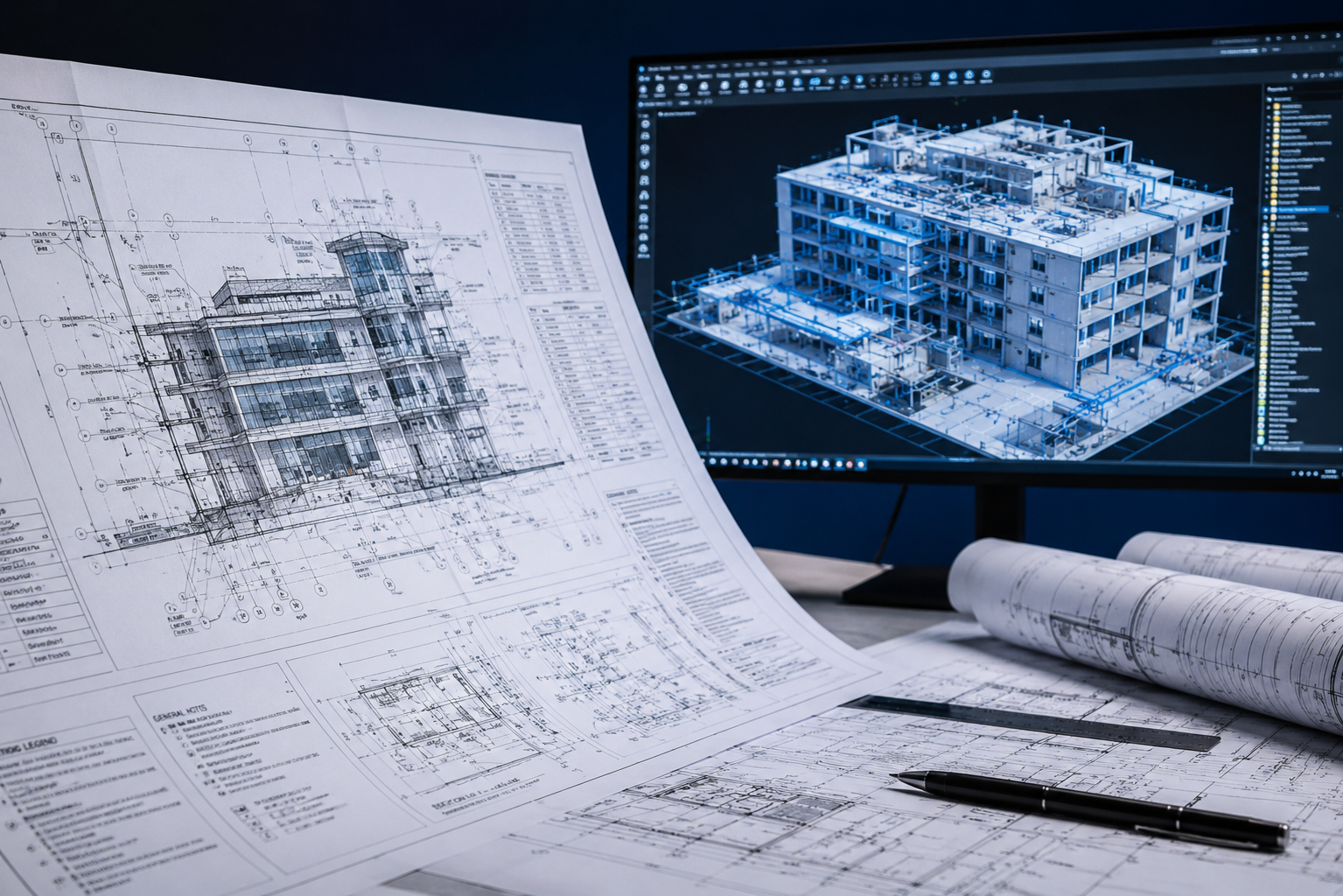
Building Information Modelling has fundamentally changed MEP coordination. In the traditional CAD workflow, MEP drawings were produced as 2D plans and sections, with coordination relying on engineers manually cross-referencing drawings — a process prone to human error and almost guaranteed to miss conflicts in congested ceiling voids or plant rooms. With BIM, each discipline produces a three-dimensional model, and these models are federated into a single environment where clash detection software automatically identifies every location where a duct intersects a beam, a pipe conflicts with a conduit, or a sprinkler head is positioned in the wrong zone.
At First Step Engineering, we produce fully coordinated MEP BIM models using Revit MEP, federated with structural and architectural models in Navisworks for clash detection. Before any drawing issue, our models are run through clash detection with zero tolerance — every hard clash and soft clash is logged, reviewed, and resolved. The result is that our construction drawings reflect a buildable, conflict-free design. Contractors working from our drawings spend their time installing systems rather than improvising solutions for design conflicts discovered on site.
Beyond coordination, BIM delivers a downstream benefit that clients increasingly recognise as valuable: the as-built model. When we update our models to reflect the as-installed condition at project completion, the owner receives a digital twin of their building's MEP infrastructure. This becomes the foundation for planned preventive maintenance scheduling, future refurbishment planning, and the kind of facilities management efficiency that reduces building operating costs over the long term. In an era where building lifecycle value is as important as construction cost, the MEP BIM model is a strategic asset — not just a drawing deliverable.