What is a Geotechnical Study?
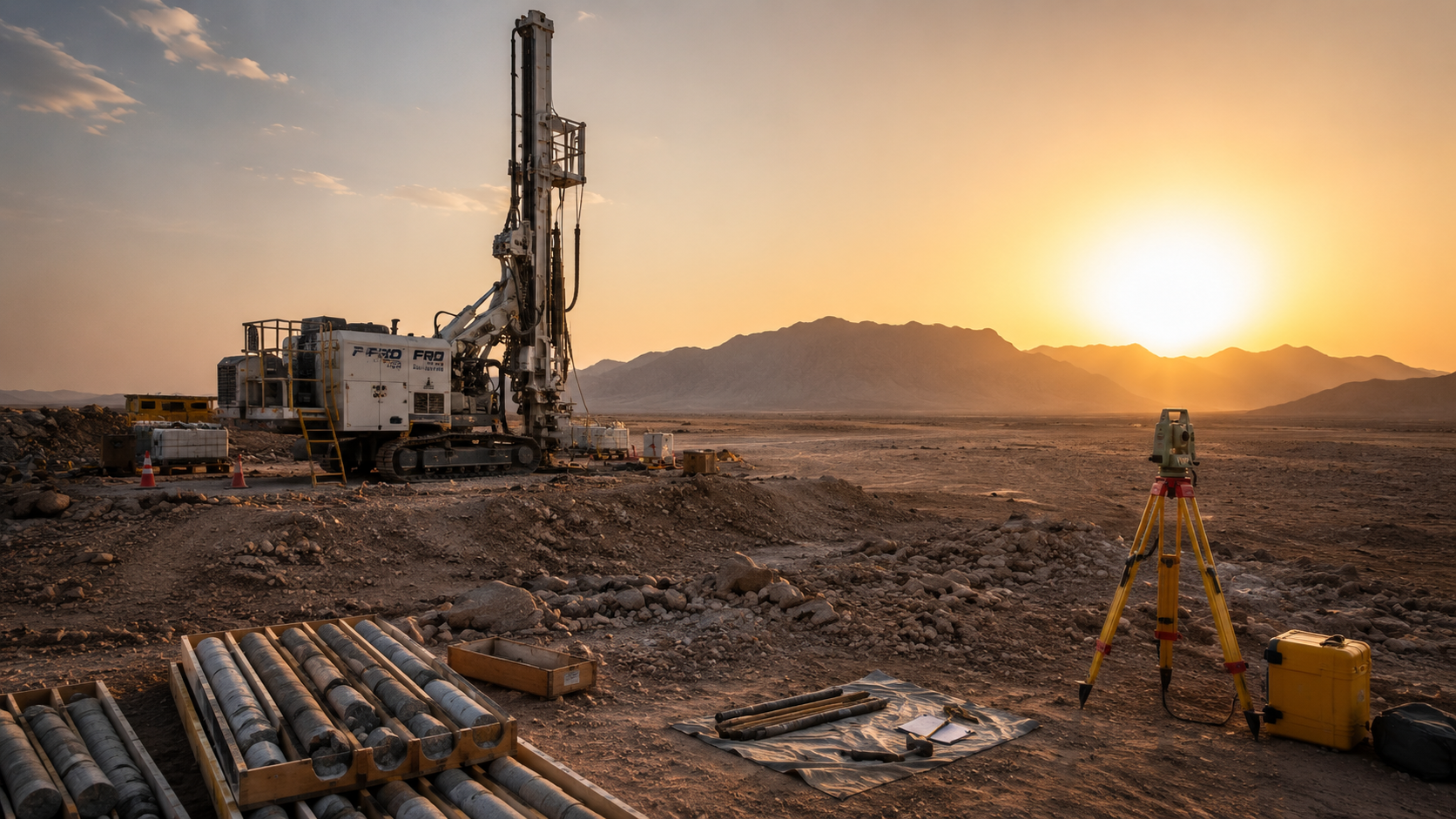
A geotechnical study — also referred to as a site investigation or soil investigation — is a systematic programme of field testing and laboratory analysis designed to characterise the ground conditions beneath a development site. It answers the fundamental engineering question that underpins all foundation design: what is the ground actually like, and what can it safely carry? The study typically involves drilling boreholes or advancing trial pits to depths below the proposed foundation level, recovering soil and rock samples for laboratory testing, and conducting in-situ tests such as Standard Penetration Tests (SPT), cone penetration tests, or plate load tests to assess the in-place strength and stiffness of the ground.
The output of a geotechnical study is a Geotechnical Investigation Report — a document prepared by a licensed geotechnical engineer that describes the soil stratigraphy beneath the site, provides engineering parameters for foundation design, identifies any geotechnical hazards such as aggressive groundwater, collapsible soils, or shallow rock, and makes specific recommendations for foundation type, depth, and bearing capacity. In Oman, this report must be submitted as part of the structural engineering package to Muscat Municipality — it is not optional documentation, it is a permit requirement for any building with more than one storey or any building where the structural design cannot be demonstrated on the basis of conservative default soil assumptions.
Ground ConditionsOman's Geological Challenges
Oman's geological diversity is remarkable given its relatively compact geography, and it creates genuinely challenging conditions for foundation engineers that cannot be addressed by simply applying Gulf-wide rules of thumb. The coastal plains around Muscat, Al Batinah, and Salalah are characterised in many areas by sabkha — a term for coastal salt flat deposits formed by the evaporation of brackish groundwater. Sabkha soils are typically weak, highly compressible, and saturated with sulphate-bearing groundwater that is aggressively corrosive to standard Portland cement concrete. A building founded on sabkha without appropriate investigation, sulphate-resistant concrete specification, and foundation treatment will experience differential settlement and structural cracking, potentially within just a few years of construction.
Moving inland, the Hajar Mountains and the alluvial fans emanating from wadi systems create a completely different geological environment. Here, the challenge is variability — wadi gravels and cobbles mixed with sand and silt, with highly variable density and the potential for loose pockets capable of significant settlement under load. Rocky outcrops introduce the opposite challenge: variable shallow bedrock that may require expensive rock-breaking excavation in some areas while allowing much shallower, more economical foundations in others. Designing a foundation system for a large building footprint on mixed wadi terrain without adequate investigation typically results in an overconservative, expensive design to accommodate the worst case — or an unconservative design that creates differential settlement problems between areas of different ground stiffness.
The interior regions introduce expansive clay soils — clays that swell significantly when wetted and shrink when dried. In Oman's climate, where rainfall events can be intense but infrequent, the seasonal moisture change in the near-surface zone can cause slab-on-grade foundations to heave and crack if the slab design does not account for the expansive soil conditions identified in the geotechnical investigation.
Sabkha Soils
Coastal salt flat deposits with high settlement risk and aggressive sulphate content that attacks standard concrete — requires specialist foundation treatment and concrete specification.
Rocky Wadi Terrain
Variable bedrock depth and mixed alluvial deposits create differential settlement risk — borehole data is essential to tailor foundation depths to actual ground conditions.
Expansive Clays
Moisture-sensitive clays that swell and shrink seasonally — slab design must account for volume change potential identified in laboratory plasticity testing.
Groundwater Table
Shallow groundwater in coastal areas and wadi plains elevates corrosion risk to reinforcement and creates waterproofing requirements for substructure elements.
What Happens Without a Geotech Report
The consequences of building without an adequate geotechnical investigation range from minor to catastrophic, and the cost of remediation is almost always a multiple of what the investigation itself would have cost. The most common outcome — and the one that is widely observed across Oman's residential sector — is differential settlement. Buildings constructed on assumed rather than investigated ground conditions develop uneven settlement as the actual soil compresses differently under different parts of the building footprint. The visible manifestations are diagonal cracking in external and internal walls, door and window frames that rack out of square, and in severe cases, structural cracking in beams and slabs.
Remediation of differential settlement in an occupied building is complex and expensive. It typically requires underpinning — installing new foundation elements beneath the existing structure to arrest movement — which requires specialist contractors, significant disruption, and costs that routinely run to several times the original construction cost of the affected elements. In cases of severe settlement or foundation failure, demolition and reconstruction may be the only viable option. Against these potential costs, a geotechnical investigation costing between 1,500 and 8,000 Omani Rials depending on scope represents exceptional risk-reduction value.
Investigation ProgrammeKey Deliverables from a Site Investigation
A properly scoped geotechnical investigation for a typical Omani residential or commercial building delivers several critical engineering outputs. The borehole logs describe the soil stratigraphy encountered at each drilling location — the depth, thickness, and description of each soil or rock layer encountered from surface to the termination depth. These logs, produced by multiple boreholes distributed across the site, allow the geotechnical engineer to interpolate the ground conditions across the full footprint and identify any significant variability.
Laboratory test results quantify the engineering properties of the soil samples recovered from the boreholes — strength parameters, compressibility characteristics, particle size distribution, plasticity, moisture content, and chemical analysis for sulphate and chloride content. The SPT N-values recorded during drilling provide an in-situ index of soil relative density and strength that is used directly in foundation bearing capacity and settlement calculations. The groundwater level recorded in the boreholes at the time of drilling and, where piezometers are installed, over a monitoring period, establishes the design groundwater conditions for substructure waterproofing and concrete durability specification.
How It Informs Structural Design
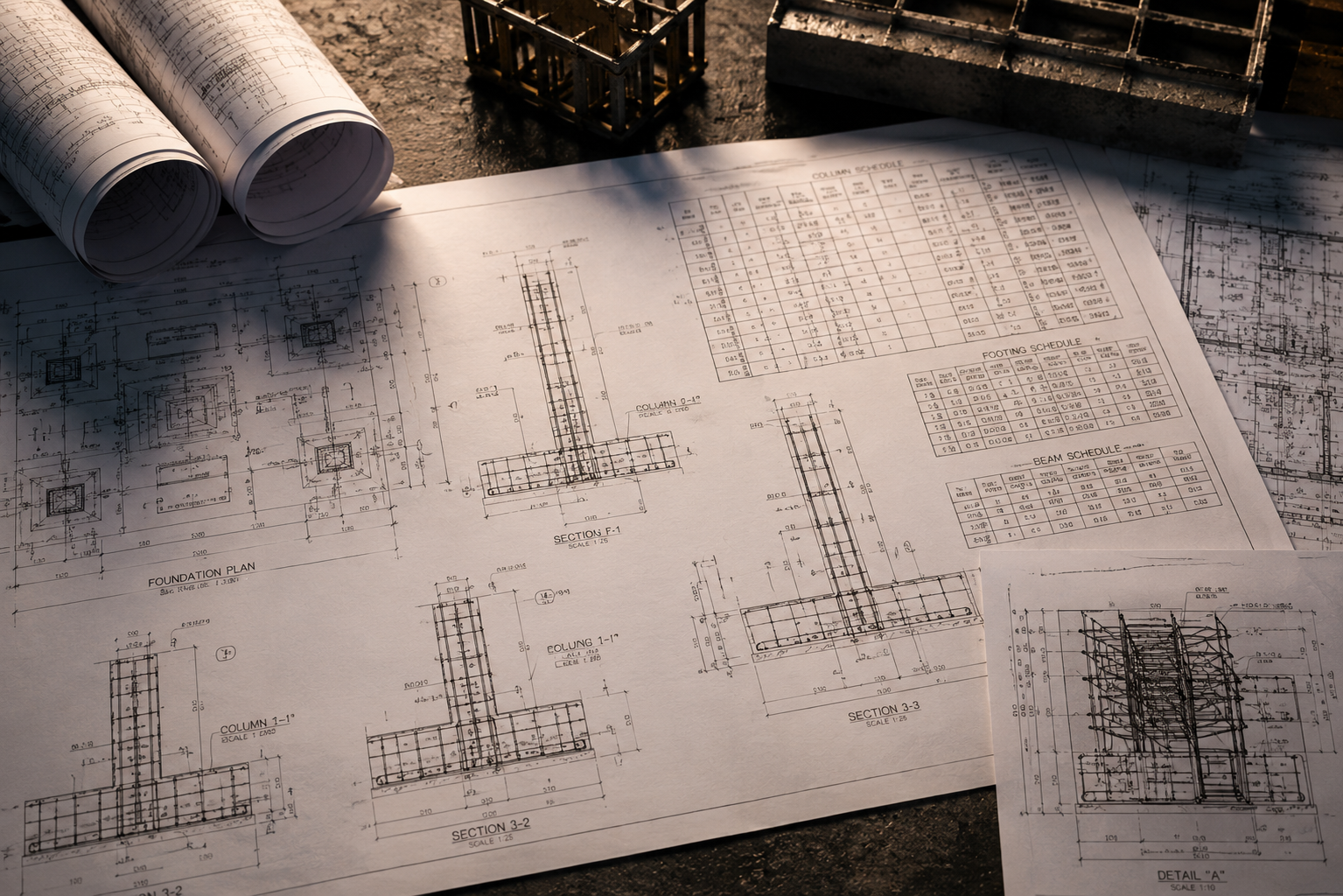
The geotechnical report is not a standalone document — it is the primary input to the structural engineer's foundation design. The allowable bearing capacity determined from the investigation governs the required size of pad footings and strip foundations. The settlement analysis determines whether differential settlement under the proposed loading is within acceptable limits for the structure type. In cases where the natural ground cannot adequately support the structure at a reasonable depth, the investigation findings guide the selection of deep foundation alternatives — driven piles, bored piles, or ground improvement techniques — and the minimum pile length required to reach competent bearing strata.
The chemical analysis results directly specify the concrete durability requirements. Where sulphate concentrations in the soil or groundwater are elevated — as they frequently are in coastal sabkha zones — the structural engineer must specify sulphate-resistant cement, low water-cement ratio mixes, and appropriate concrete cover to reinforcement in accordance with BS 8500 or equivalent durability specifications referenced in the Oman NBC. Failure to specify appropriate concrete durability in aggressive ground conditions results in accelerated carbonation and chloride ingress that triggers reinforcement corrosion within 10 to 15 years rather than the 50-year design life the structure should achieve.
Financial CaseCost vs Risk: The Numbers
For a typical residential villa in the Muscat area, a properly scoped geotechnical investigation — typically two to three boreholes with standard laboratory testing — costs between 1,500 and 3,000 Omani Rials. For a larger commercial building or multi-storey residential project requiring six to ten boreholes and more extensive laboratory testing, the investigation cost typically ranges from 4,000 to 8,000 Omani Rials. These figures represent a fraction of one percent of total project construction cost on any building of meaningful scale.
Against this investment, consider the cost of the risk it mitigates. Minor differential settlement remediation — crack repair and cosmetic reinstatement — routinely costs 5,000 to 20,000 Omani Rials. Structural underpinning of a settled building foundation costs 30,000 to 150,000 Omani Rials depending on severity and access. In the worst cases, complete demolition and reconstruction of a failed structure represents a total loss of construction investment. The expected value calculation — probability of a problem multiplied by the cost of that problem — almost always returns a compelling case for the investigation, even on small projects. On larger projects, where the potential loss is proportionally greater, the case is overwhelming.
At First Step Engineering, we require a geotechnical investigation for every project we design. It is not a recommendation we make and leave to the client's discretion — it is a professional requirement, because we cannot sign and stamp a responsible structural design without knowing the ground conditions on which that design depends. Developers who work with us benefit from our established relationships with Oman's leading specialist geotechnical investigation contractors, ensuring that investigations are scoped correctly, conducted professionally, and reported in a format that directly supports our structural design process without unnecessary delay.